Always free shipping · 30 days to decide · Made in Orange, California
The Camp Chair Cup Holder.com ← back to the camp chair page

The camp chair file

Why drinks tip over in a camp chair — and what actually holds one at the campsite

A camp chair earns its keep by working wherever there's no furniture — which means the drink beside it gets parked there too, with nowhere built for it. Here is the physics behind why the ground, the folding frame, and the mesh armrest loop all fail a drink in different ways, what campers try instead and where each fix stops working, and what a base actually has to do to end the leaning-then-tipping cycle for good.

The ground under a camp chair was never built to hold anything flat

Grass humps, root-lumpy packed dirt, campground gravel — none of it is a plane, and none of it holds still. The physics is simple: pressure is weight divided by contact area, so the narrower a footprint, the more that weight concentrates into whatever it's resting on. Camp chairs already prove the point. Seat heights across the category run from about 5 inches on low ultralight models to about 20 inches on tall quad chairs, but every one stands on thin, small-diameter feet — and on soft ground, those feet sink. It's documented enough that Helinox, a leading ultralight chair maker, sells ball feet and ground sheets specifically to keep legs from augering into sand and soft soil.

A drink set down nearby plays out the same physics smaller. A standard can's base runs about 2.6 inches across, so its weight lands on whatever grass blades and root humps sit underneath it, not on a flat surface — it teeters on the highest points in reach, waiting for a boot, a dog lead, or a marshmallow-stick reach to find it. And once the fire is the only light left, the ground beside a chair leg goes dark along with everything else, so whatever's balanced there is being read blind.

Why the sewn-in mesh loop lets go

The armrest cup holder on a classic quad chair is a fabric or mesh loop stitched to one point on a folding frame — a single fixed diameter chosen at the factory, hanging off a structure that flexes with every shift in weight. Independent gear testers describe the results bluntly: the built-in holder on the ENO Lounger DL as floppy, the GCI Freestyle Rocker's as flimsy. Sizing misses in both directions at once — reviewers found the REI Campwell's holder so oversized that a lone 12 oz can rattles and tips inside it, while the Coleman Broadband's mesh is cut so tight a can has to shed its koozie just to fit.

On reclining chairs the flaw becomes the mechanism. Reviewers of the Nemo Stargaze report its sling-mounted holder doesn't keep a drink upright once you actually get up — the chair's own motion is the spill, and it happens most reliably at the exact moment both hands go to the frame to stand. Low ultralight chairs make the same move worse: a seat sitting close to the ground forces a forward lunge onto the frame to stand, twisting the sling — and whatever's riding the seat-edge holder twists with it.

Leverage decides whether a shove becomes a spill

A container goes over when a sideways force — a bumped knee, a dog lead, a chair dragged forty yards down the sideline — creates more turning force around its base edge than the container's own weight can resist. Force applied high up gets more leverage; a wide base gets more leverage back, from gravity pulling the container down and level. That's why a tall, narrow drink loses to a shove that a short, wide one shrugs off, and why a can loses more of its own resistance as it empties — less liquid means less weight anchoring the base, so the same nudge wins more easily against less to fight it.

The mesh loop compounds this instead of solving it, because a sagging loop isn't a rigid base to resist around — it's a second moving part. Whatever leverage the frame absorbs, from a hand grabbing the arm to stand or a chair dragged sideways after play, passes straight through the fabric to the drink riding in it. A can held in a fixed, low grip resists a shove the loop simply transmits.

Wondering about your specific cup? The fit database has sourced base measurements for 30+ containers — Stanley, Red Bull, Yeti, and the honest no's.

What campers try instead, and where each one stops working

The chairs with no built-in holder push the fix onto an accessory: a sold-separately mount with a published compatibility list that excludes several of the same brand's other chairs, attached during assembly, not decided on a whim at the site. Generic clamp-ons trade that for a different problem — they need the right tube diameter to bite, and a full drink hangs off-axis from the clamp, leveraging it loose on a frame that already flexes.

Folding camp side tables solve the flat-surface problem and fail their own leg test. Wobble is a named trait of the category — the Camp Time Roll-A-Table gets flagged for lacking cross-bracing, and even heavier folders still show sway. One of four legs is always floating on real campsite ground, a slatted roll-top puts ridges under a cup base, and a table light enough to pack is light enough for a knee, a dog, or a gust to shove.

Ground-spike holders only work where the ground accepts a spike, which rules out compacted gravel pads, hard-packed dirt, and a tailgate lot's asphalt — loose sand just makes the spike wallow. The cooler lid is the free table with a trapdoor: every refill clears the whole surface, and between openings the molded ridges and condensation keep a flat-bottomed cup from sitting flush. The picnic table is stable and none of those things, and still not much help — it sits where the builders put it, not where the chairs gather once the fire ring becomes the evening's real furniture.

What actually holds a drink at a campsite

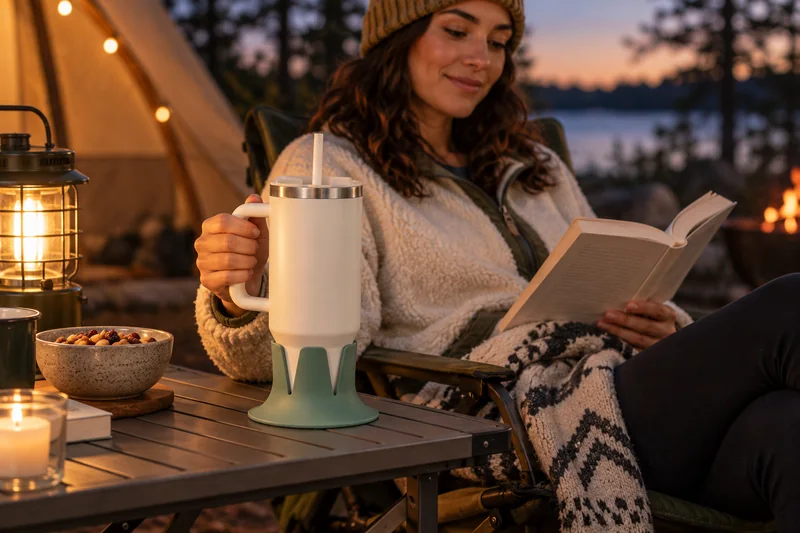
Strip the failures down and three requirements fall out. The base has to spread weight across the ground instead of concentrating it — a wide, flexible footprint lying across many grass blades or gravel chips, rather than teetering on the few highest points, keeps the drink from ever finding a lean to start from.

The grip has to hold the container by its base, not its rim or walls. A fin system built to grip the bottom inch reads a container the same way regardless of what's above that inch — a standard 2.6-inch can, a slimmer 2.25-inch seltzer can, or a 3.1-inch Stanley 40 oz tumbler base all land inside the 2 to 3 inch range Steadi Labs builds the base around, and the flexible fins seat bases as wide as 3.15 inches for a snug fit — enough for a Stanley 30 oz right at that edge.

And the base has to move with the ground instead of fighting it. Chair legs settle unevenly through a rainy evening, and a rigid stake or a four-legged table has no answer for ground that keeps re-shaping under it. A flexible base flexes with that disturbance and settles back level instead of leaning further with each shift — and because it isn't clamped to any one chair, it sits on the ground beside whichever one came out of the trunk, the quad, the low sling, or the kids' sideline seat, moving to the tailgate lot or the picnic table just as easily.

None of that requires a mesh loop sized right, a table that doesn't wobble, or ground willing to be flat — just a base that resists tipping and settles in on whatever the campsite actually hands it, fire ring to sideline to tailgate lot.

Grab yours at steadilabs.com →

You'll finish at steadilabs.com — Steadi Labs is the manufacturer.